

Unfortunately in most cases there is not a manual on how to raise children with additional needs, because every child is different with different challenges. In Aiya’s instance in particular, there are so few cases of MOPD type 1, making an educated guess about her health issues and development can be difficult given the lack of information. With more common syndromes, professionals may be able to give a fairly accurate prediction of the development path a child could take and the health risks they may have along their life as there are more children with the condition and subsequent studies to draw reference from. For instance, it has not yet been confirmed to me what having an absent corpus collosum actually means, and no one can predict what this means for Aiya. There is a lot about the brain that medical science has yet to figure out and a lot that Aiya is doing that cannot be explained or is unexpected.
I’ve learnt not to get frustrated when people don’t have the answers to my questions and that ultimately I am the expert when it comes to Aiya. There is no health professional that knows more about my child than I do, but I do value the opinions, expertise and advice that the amazing professionals give me with regards to Aiya’s care. We have been very fortunate that with most of the professionals we’ve been in contact with, there is a collaborative approach to Aiya’s care. 90% of these professionals will always ask for my opinion after they’ve shared their thoughts on an issue. This is partly because they are learning too and they have not come across a child comparable to Aiya before. That does not mean I don’t have to be pushy at times to get what I believe is the right outcome for Aiya. In these cases I need to have a few counter arguments to what I’m being told, which are non-emotional and based on the facts I have to hand.
As parents though we rule by our heart and our gut, sometimes the decisions we make are based on instinct rather than anything concrete and it’s hard to present these when there are facts that are going against the balance of probabilities. In my experience though my gut has always been right and parents will often say ‘I knew something wasn’t right, but I couldn’t put my figure on it’. My advice is to always trust that gut instinct.
My biggest lesson from having Aiya is learning to enjoy life and not worry too much. Aiya will take the path she is meant to take and we have to continue with as normal a life as possible, for our sake and for the sake of our son. Life is unpredictable and for a person that likes predictability that can be hard. I’ve learnt that the best way to cope is to ride the waves and when the waves are strong wait for them to pass, then get up and keep moving forward.
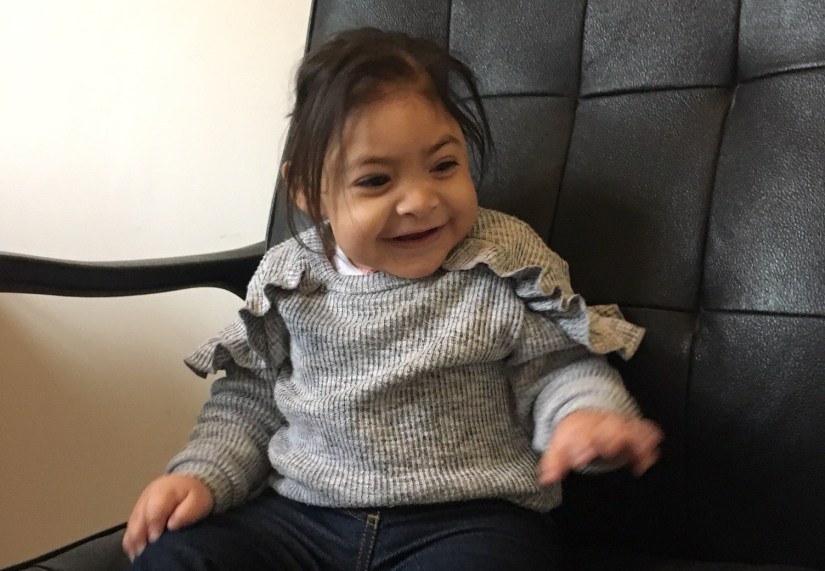

 Project Aiya